
An Easter Reflection
Crucifixion, Burial, and the Stirrings of Resurrection in the West

An old Jewish man is asked how the Jews have survived centuries of persecution. He shrugs: “When they come with swords, we outlast them. When they come with laws, we outlast them. When they come with apologies and guilt trips… we’re still working on that one, but history is on our side.”
Easter invites reflection on death and life renewed. As a lapsed Catholic who has found herself drawn back towards the Church through my son’s service as an Anglican chorister, I have watched as many of the traditions and beliefs I have known have morphed not only into external indifference but into an internal habit of apology. Institutions once rooted in Christian confidence now seem uncertain whether they are custodians of a noble inheritance or prosecutors in an endless case against it. Yet Easter remains the feast that teaches Christians to distrust the evidence of the tomb. Even where decline is real, the pattern of Christian history repeats with stubborn constancy: abasement, exhaustion, and then an unexpected return. As G.K. Chesterton observed, “Christianity has died many times and risen again; for it had a God who knew the way out of the grave.”
This year that pattern has acquired unusual force. Today, 12th April 2026, Orthodox Christians celebrate Easter—Pascha—while we in the West marked ours on 5th April. Holy Week observances in Jerusalem unfolded under the shadow of regional conflict. Iranian missile strikes and provocations by Iran and its proxies repeatedly endangered Christian holy sites in the city, including areas near the Church of the Holy Sepulchre. These threats prompted stringent security restrictions across the Old City, including checkpoints and limits on gatherings, which disrupted worship, most notably preventing senior clergy from celebrating Palm Sunday Mass at the Holy Sepulchre. Access to the holy sites improved only after a fragile ceasefire was announced earlier this month, though constraints on public observances persisted into the Orthodox feast.
In Eastern Europe, Russia and Ukraine implemented a declared 32-hour ceasefire to mark Orthodox Easter, yet Ukrainian military reports recorded over 400 violations—primarily shelling and drone strikes—within hours of its commencement, with mutual accusations continuing into the feast itself. Resurrection is therefore not merely a metaphor this year. It is being proclaimed in the midst of blockade, fear and political fracture.
The contraction of Christian identification across the West remains substantial. In the United States, Pew’s 2023–24 Religious Landscape Study found that only 62 per cent of adults still identify as Christian, down sharply from 78 per cent in 2007, while 29 per cent are now religiously unaffiliated. Yet the same study indicates that the long decline has slowed and may have levelled off in recent years. This pause does not herald a triumphant secular future; rather, it suggests a civilisation encountering the practical and spiritual limits of what unbelief can sustain. Meanwhile, beyond the West, the Judeo-Christian tradition faces far graver threats. According to Open Doors’ World Watch List 2026, more than 388 million Christians—one in seven worldwide—suffer high levels of persecution and discrimination for their faith, with 4,849 believers murdered in the reporting period alone, 3,490 of them in Nigeria. Christians are being slaughtered across vast swathes of the world, often at the hands of radical Islamist militants. Our faith’s emphasis on forgiveness and contrition—virtues at the very heart of Easter—risks, when severed from doctrinal confidence, clear judgement, and the willingness to name evil plainly, fostering a progressivist reluctance in much of the Christian West to confront this reality with clarity. In the name of multicultural sensitivity or institutional self-criticism, communities that once proclaimed the sanctity of every human life look away while their brothers and sisters in the faith are systematically targeted. Such silence does not reflect authentic Christian humility; it reflects a loss of nerve that leaves the persecuted undefended and the inheritance diminished.
The difficulty in Britain and much of Europe is not simply disbelief. It is embarrassment. Christian institutions have too often absorbed a moral grammar of guilt while losing confidence in creed, judgement, redemption and truth. They continue to speak in ethical tones, but often without the doctrinal spine that made those ethics intelligible. Roger Scruton diagnosed this habit better than most. His term was oikophobia: the impulse to recoil from one’s own inheritance, to distrust home because it is home, and to assume that piety towards one’s own tradition is somehow morally suspect. What follows is not humility but vacancy.
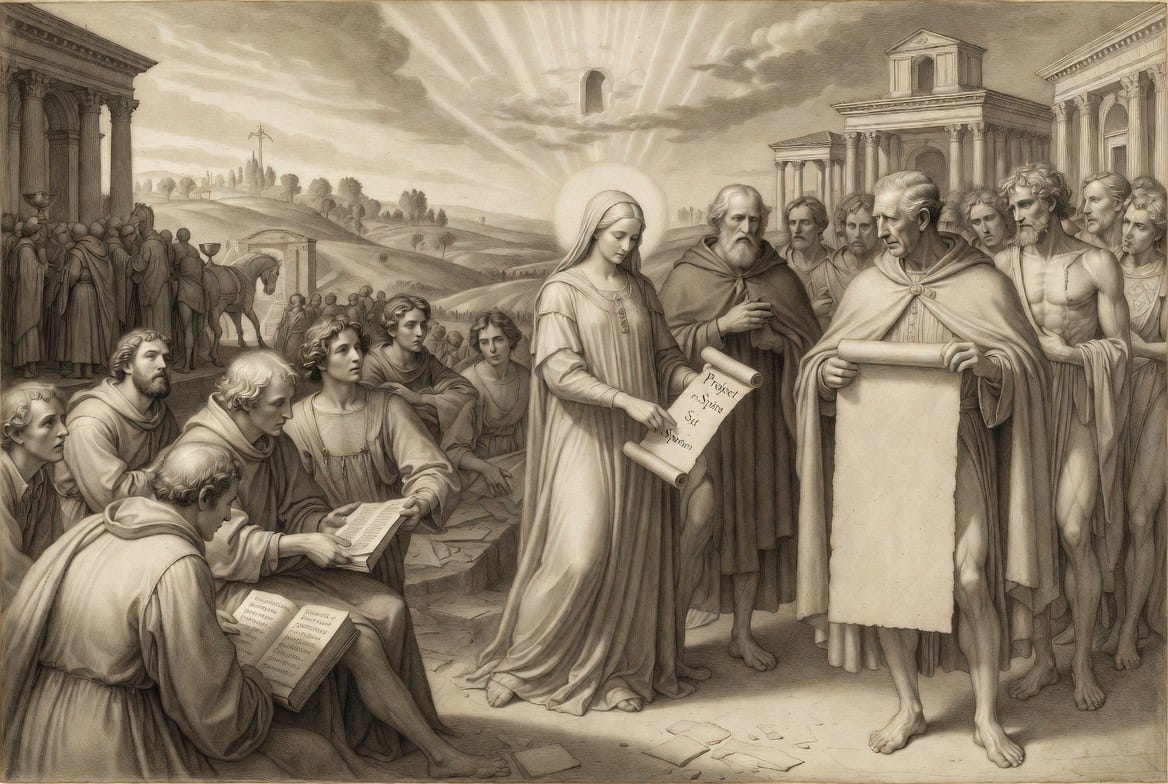
That vacancy is then filled by ritualised self-accusation. The Church of England’s £100 million Project Spire, intended to address historic links to African chattel enslavement, is the most obvious recent example. The Church Commissioners present it as part of their response to that history, and Archbishop Sarah Mullally, installed as the 106th Archbishop of Canterbury on 25th March 2026, has defended the broad moral case for such action. The symbolism is unmistakable: a national Church with dwindling congregations and struggling parishes chooses to project seriousness through institutional penitence rather than institutional renewal. This selective emphasis becomes harder to ignore when set against present realities. The latest global estimates indicate that 50 million people were living in modern slavery in 2021, including 28 million in forced labour and 22 million in forced marriage, some 10 million more than in 2016. Contemporary slavery is not a metaphor, nor merely an inherited stain; it is an existing crime on a colossal scale. A civilisation committed to moral integrity might reasonably be expected to devote at least as much rhetorical energy to the living captive as to the dead ledger.
It is this imbalance, rather than repentance itself, that troubles many Christians. Repentance is at the heart of the faith. But Christian repentance has traditionally been ordered towards amendment of life, forgiveness, and renewal. It is not meant to become an endless public performance of self-negation. Once severed from redemption, repentance curdles into theatre. It becomes a way for institutions to display moral sensitivity while avoiding the harder task of defending what they are for.
The monarchy, too, reflects this wider mood of hesitation. The royal household marked the 2026 Royal Maundy at St Asaph, and the official website still prominently carries the King’s 2025 Easter message. As of this Orthodox Easter, however, there appears to be no comparable standalone 2026 Christian Easter message on the official royal site. At a season that stands at the centre of the Christian calendar, such restraint from the Supreme Governor of the Church of England is itself telling. It fits the wider pattern of symbolic distance, careful ecumenism, and a reluctance to speak from within the fullness of Christian particularity.
The story does not end there. One reason the atmosphere has shifted in the past year is that signs of religious reawakening, though still tentative, are no longer fanciful. Barna reported in September 2025 that Gen Z and Millennials in the United States were attending church more frequently than before, describing young adults as leading a resurgence in attendance. Pew likewise suggests that Christian decline in America has at least slowed. These are not proofs of revival in any triumphant sense. They are, however, signs that the secular settlement may be less stable than its advocates once assumed.
This is where Eastern Orthodoxy acquires its significance. Its attraction lies not in novelty but in density: doctrine that has not been endlessly diluted, liturgy that assumes transcendence is real, and a sense that faith belongs not merely to private feeling but to a people, a memory, and a way of life. On this day of Orthodox Pascha, that witness feels especially resonant. In a fractured Christian world, the differing yet proximate feasts remind us that renewal need not mean innovation. Sometimes it means return: to ancient language, inherited forms, and truths that do not ask permission from the age.
Ayaan Hirsi Ali has described, from the far side of both Islam and atheism, why that return matters. The secular world can be administratively competent and morally eloquent, but it struggles to answer the deepest human questions: what man is for, why suffering must be borne, what binds freedom to duty, and how guilt may be forgiven rather than merely managed. Christianity alone, she argues, offers not just an ethic but a civilisation, and not just a civilisation but a hope capacious enough to survive despair. Whether or not one follows her all the way, she has understood something many of the churches have forgotten: a culture cannot endure on critique alone.
That is why Easter remains the proper lens. The Christian inheritance in Britain and the wider West has undoubtedly suffered contraction, compromise, and self-doubt. Churches have too often spoken as though their first obligation were to justify their own continued existence. But Easter does not begin with confidence. It begins with abandonment, fear, and what looks very much like defeat. The tomb is not a rebuttal to Christianity; it is part of the pattern by which Christianity understands the world and, through it, renews civilisation itself.
So on this Orthodox Easter Day, the more interesting question is not whether Christianity has declined. It has. The question is whether what now presents itself as decline may also conceal the conditions of return. This year, with Jerusalem emerging from restriction into worship, with younger generations showing fresh curiosity about faith, and with the ancient rhythms of Pascha once more proclaimed, the old pattern is visible again. Apparent burial. Then movement. Then life.
The Judeo-Christian inheritance has survived deeper crises than elite embarrassment or institutional uncertainty. As Antigone declares in Sophocles’ tragedy, “It is the dead, not the living, who make the longest demands.” Yet this inheritance has formed the moral and cultural bedrock of Western civilisation, animating its commitments to the sanctity of the individual, the rule of law tempered by mercy, the dignity of the weak, and the possibility of forgiveness that liberates societies from cycles of vengeance. It has survived persecution, schism, decadence, and the collapse of empires. It may yet survive the age of apology too. But it will do so not through further self-diminution. It will do so through memory, fidelity, and the recovery of love for what was handed down. Scruton called that love of home oikophilia. Christians might call it, more simply, gratitude. And gratitude, unlike guilt, is capable of resurrection.